

Accelerating Army Innovation Through HPCCs

UTRS has spent nearly two decades optimizing the High Performance Computing Cluster (HPCC) at the DEVCOM Armament Center at Picatinny Arsenal. We’ve expanded capability, improved reliability, and streamlined how dozens of modeling and simulation tools are licensed and used. The result: faster concept-to-release timelines, fewer bottlenecks, and a stronger, more collaborative R&D community.
project details
Client
Army Combat Capabilities Development Command Armaments Center (DEVCOM AC)
Location
Picatinny Arsenal, NJ
Services
Industries
High Performance Computing Clusters are behind some of the most significant scientific advances of our time.
Also known as HPCCs, these systems entail thousands of interconnected computers working together through a high-speed network to perform modeling and simulation at a massive savings of both time and money. However, while they are highly valued by the research and development community, HPCCs typically present significant operational challenges.
Universal Technical Resource Services, Inc. (UTRS) has been managing the HPCC for the DEVCOM Armament Center at the Army’s Picatinny Arsenal in New Jersey for nearly two decades. This goes back to the days when the organization was known as ARDEC, the Army’s Research, Development, and Engineering Command. Along the way, UTRS has mitigated some of the most pressing issues while improving execution to help shape the Armament Center HPCC into an extremely effective and efficient tool.
Modeling and simulation demands at the Armament Center encompass a wide variety of tasks such as airflow around artillery shells in motion and electrical circuit simulations under varying environmental conditions. While each simulation may take days or weeks to model to an extremely fine resolution, each one that is successful can save the Army thousands of dollars, or more, by avoiding the need to perform physical tests in the field using costly ultra-high speed photographic equipment.
However, prior to 2007, the only high-performance computing option for scientists and engineers at Picatinny Arsenal was to travel to the Army Research Laboratory (ARL) in Maryland to physically deliver, compute, and retrieve massive sets of modelling data. It took one trip to run tests and then a return trip with external hard drives to download the results, which then still needed to be processed at Picatinny Arsenal. Additionally, those Armament Center scientists and engineers were competing with the rest of the Army for computing time at ARL.
Near the end of 2006, at the Armament Center’s request, UTRS was given the task to stand-up a better solution at Picatinny Arsenal. By early 2007, a 96-node cluster was in production.
With Rich Alford from UTRS at the helm, the Armament Center HPCC environment has evolved over nearly two decades from the original 96-node, 384-core cluster to include multiple environments, some with nearly 4,000 cores, with each core essentially being its own computer. Improvements in network technology now allow remote access and post-processing of large data files, eliminating the need for the physical transportation of data.
The result is a massive acceleration of the process from concept to release for many of the Armament Center’s cutting-edge developments. And more importantly, it is a resource dedicated exclusively to Armament Center researchers and scientists.
Getting the Armament Center HPCC where it is today required substantial work by UTRS. A significant part of that evolution involved streamlining and optimizing the licensing process for the more than three dozen modeling and simulation packages run on the HPCC and high-performance workstations, so that none of the licenses sat idle.
While this was a hefty task, it paid big dividends.
Alford and UTRS developed a system that allowed scientists and engineers to work together through shared licenses in the most efficient way possible, thereby creating a single HPCC R&D community. As a result, the Armament Center also posted significant savings by purchasing fewer licenses.
UTRS’s administrator role requires continual attention to perform upgrades and complex configuration of the modeling and simulation packages for users. Additionally, much of the output from individual modeling and simulation jobs requires extra configuration work before the results can be properly processed. All of this takes extensive time, effort, and expertise, which UTRS has honed over the years.
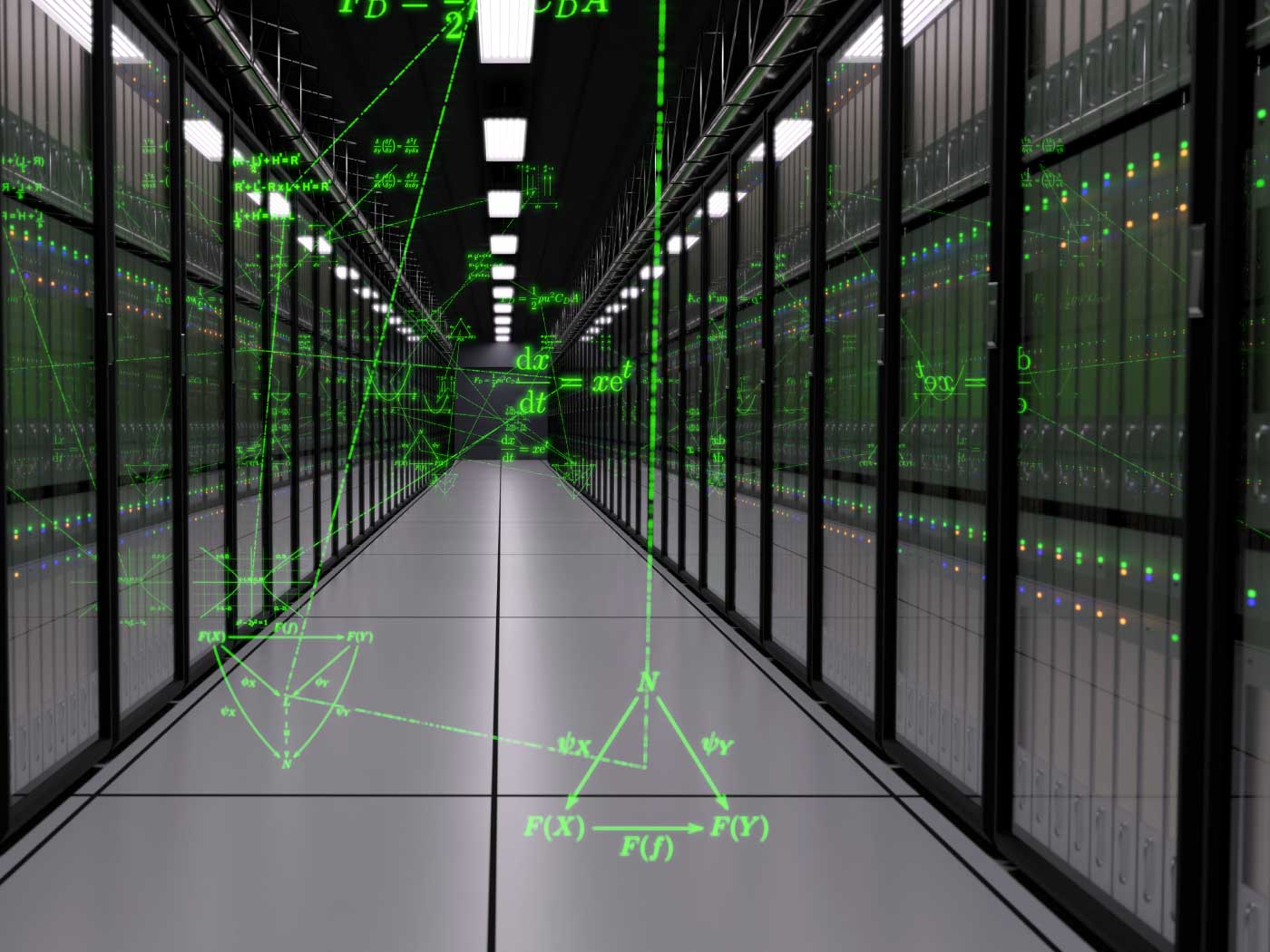
Other key support involves ongoing installation and hardware issues in the data center, such as constantly working through warranty support for equipment replacement and addressing the constantly growing vital need for data center power and cooling.
“Trying to maintain that is quite a challenge, as HPCCs generate a tremendous amount of heat.” Alford says. “We have heat sensors and monitors in the data center, racks, and computing nodes.”
Currently, the installation relies on “chiller doors” for efficient cooling of individual racks instead of HVAC units to cool the entire space. Chiller doors, also called Rear Door Heat Exchangers (RDHx), are installed directly onto the backs of server rack cabinets to capture and remove heat precisely where it is generated for highly localized, efficient cooling. These provide more efficient HPCC temperature regulation than traditional solutions and remove the requirement for whole-room cooling solutions.
Contact us to start the conversation on how we can assist your R&D computational efforts.