


UTRS Advanced Manufacturing’s management system was recently re-assessed and re-certified to AS9100D / ISO 9001:2015, covering the full lifecycle of our work: design, fabrication, assembly, repairs, and retrofitting of customer industrial machinery and components. Our Robbinsville facility has held this certification continuously since 2011, meaning this is not a one-time achievement, but a standard we’ve been independently audited against, year after year, for over a decade.
If your business has nothing to do with aerospace or defense why should you care?
AS9100D is not a common credential. Nationally, one widely used industry directory tracks only about 110 machine shops in the entire country that hold it. That’s a minute fraction of the tens of thousands of manufacturing facilities operating across the U.S. In the Mid-Atlantic, independent research puts AS9100D-certified precision manufacturers at roughly one in ten facilities, even among shops specifically doing machining, fabrication, and assembly work.
Most of your potential manufacturing suppliers never pursue it, because it’s genuinely hard to earn and expensive to maintain. That scarcity is exactly what makes it useful information for you.
Here’s why: AS9100D was built for industries where a missed defect isn’t just an inconvenience but instead a catastrophic failure. It provides institutionalized predictability. AS9100D amplifies standard ISO 9001 requirements by forcing a hyper-focus on three operational pillars:
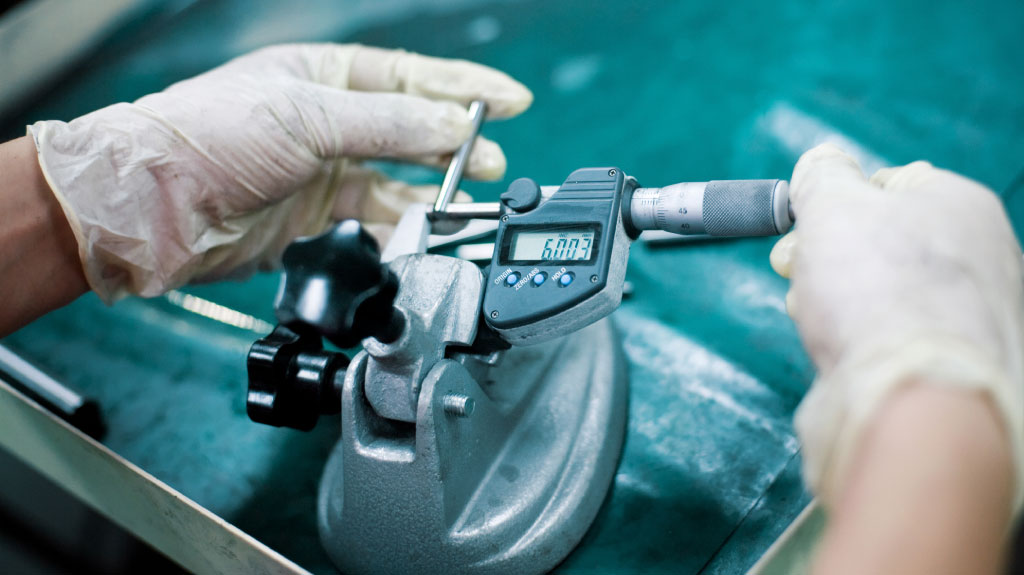
- Obsessive Risk Management: Potential failure modes are systematically evaluated before raw material ever meets a CNC spindle. For custom machinery or complex rebuilds, this translates directly to fewer engineering changes, zero surprise delays, and rock-solid reliability.
- Flawless Supply Chain Traceability: Every bolt, alloy billet, and specialized coating is tracked meticulously back to its mill source. This tier of counterfeit part mitigation and material validation provides air-tight legal and operational compliance for high-liability commercial sectors like medical equipment or heavy industrial logistics.
- Strict Configuration Control: If your equipment requires a retrofitted modification or a repeat production run years down the line, our system ensures perfect continuity. The exact design iterations, tooling specs, and testing protocols are locked down, preventing operational drift.
None of those requirements is aerospace-specific.
It’s simply what disciplined manufacturing looks like when the cost of error is high.
But let’s face it: if you’re buying custom industrial machinery, complex components, or precision retrofits, the cost of error is always high. A late delivery, an undocumented process change, or an unverified part can cascade into downtime, warranty exposure, or a safety incident on your production floor. That’s true if you’re manufacturing industrial automation systems, energy infrastructure, medical technology, research equipment, or custom production machinery.
For non-aerospace buyers, the real value of AS9100D is not the label; it’s the management rigor behind the certification. When you work with a shop that’s earned and continuously held AS9100D, you’re not paying for a certificate. You’re buying a documented, third-party-verified habit of doing things right the first time – and being able to prove it, on paper, months or years after the job is done. The distinction translates to practical business value. AS9100D-certified manufacturers are structured to identify risks earlier, control changes more rigorously, maintain stronger documentation, improve repeatability, and continuously refine manufacturing processes. These practices contribute to predictable quality, dependable delivery, and fewer costly surprises throughout a project’s lifecycle.
Recertification also tells you something about continuity, longevity, and maturity. Companies don’t maintain a standard this rigorous by accident. And they don’t maintain it for fifteen years to impress a market that doesn’t ask for it. They maintain it because it’s a core part of their operating system and how they run their business – every job, every customer, every day.